

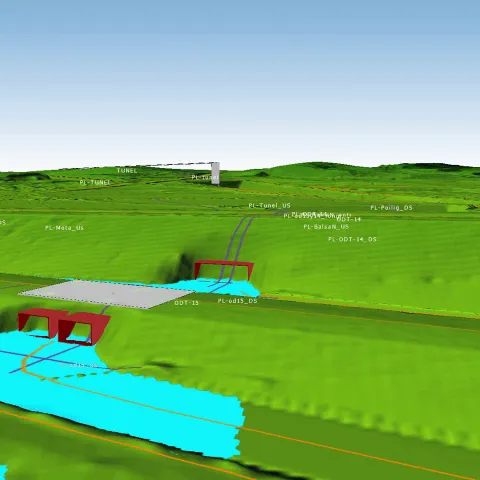
At Ineco, we work to understand how water behaves across the territory and to anticipate its effects on infrastructure and urban environments. Through hydrology and hydraulic studies, our technical teams model scenarios involving intense rainfall and flood events to support decision-making aimed at reducing risks and improving infrastructure resilience.
Susana Linares, civil engineer and head of Ineco’s flood‑risk assessment team, explains that hydrology focuses on understanding rainfall patterns and the conditions under which certain flow rates may occur. Hydraulics, meanwhile, examines the obstacles that water encounters along its path and how it interacts with the surrounding environment.
To do this, specialists recreate the terrain using digital simulators and then introduce different rainfall scenarios. This enables them to predict the potential effects of a major flood event in a specific area and to evaluate possible solutions. Based on these models, decisions can be made to protect or relocate infrastructure, identify areas unsuitable for certain uses, or implement early‑warning systems. “If we don’t understand how water behaves and the wrong decisions are taken, the consequences can be even more damaging than if the water followed its natural course,” Linares notes.
These activities form part of the suite of solutions that Ineco develops to improve flood‑risk management and support climate‑change adaptation. This approach is explored in greater depth in the article A Flow of Solutions, available on Connected.
The team’s work therefore focuses on finding a balance between infrastructure development and the natural behaviour of water. “Our job is to ensure that the land and the water coexist without conflict,” Linares concludes.
The flood‑risk team at Ineco is led by Susana Linares and comprises six other professionals: Ana Alonso, Gloria Rosa, Almudena Morán, Fernando Segura, Kevin Murga and Ana Rodríguez Paterna.


