
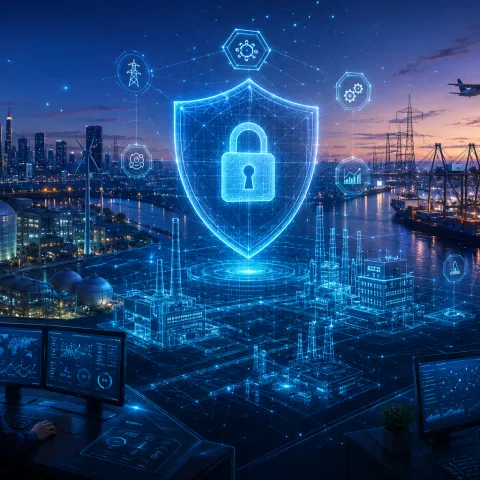
Critical infrastructure has never been so interconnected. Railway stations, energy networks, ports and airports now operate through thousands of systems that constantly exchange information. This evolution has significantly enhanced operational capabilities, but it has also increased the complexity of protecting such environments.
In this context, Ineco is developing Cyber Twin, an innovative solution that combines digital twins, artificial intelligence and cybersecurity to help anticipate threats before they become operational problems.
The first step involves building a comprehensive view of the infrastructure, identifying assets, connections and behaviours in order to obtain an accurate picture of how the system functions as a whole. Based on this understanding, a digital twin is created, a virtual replica capable of reproducing the behaviour of the real infrastructure. This environment makes it possible to monitor system evolution, analyse potential scenarios and test responses without disrupting day‑to‑day operations.
The real value, however, emerges when this replica begins to learn. Using artificial intelligence and machine learning techniques, Cyber Twin can identify anomalous behaviour, recognise potential attack vectors and assess how a threat might spread throughout the system. The aim is not merely to detect incidents, but to understand them and anticipate their consequences.
The solution also incorporates mitigation capabilities designed to limit the impact of incidents, maintain operational continuity and reduce recovery times. Rather than relying solely on reactive models, this approach promotes a dynamic defence, capable of adapting to an environment in which threats are constantly evolving.
Its design also enables a multi-sector application. While it is particularly suited to railway environments, the model can be extended to any infrastructure where availability, security and service continuity are critical.
As digitalisation continues to reshape how infrastructures operate, Cyber Twin raises a complementary question: how must protection systems evolve to keep pace with this transformation? The answer lies in combining knowledge, simulation and artificial intelligence within a single environment: a model capable of observing, understanding and acting upon increasingly complex systems, helping organisations make faster and better-informed decisions.