
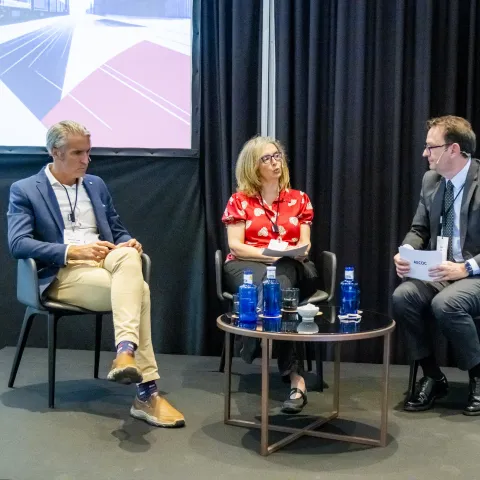
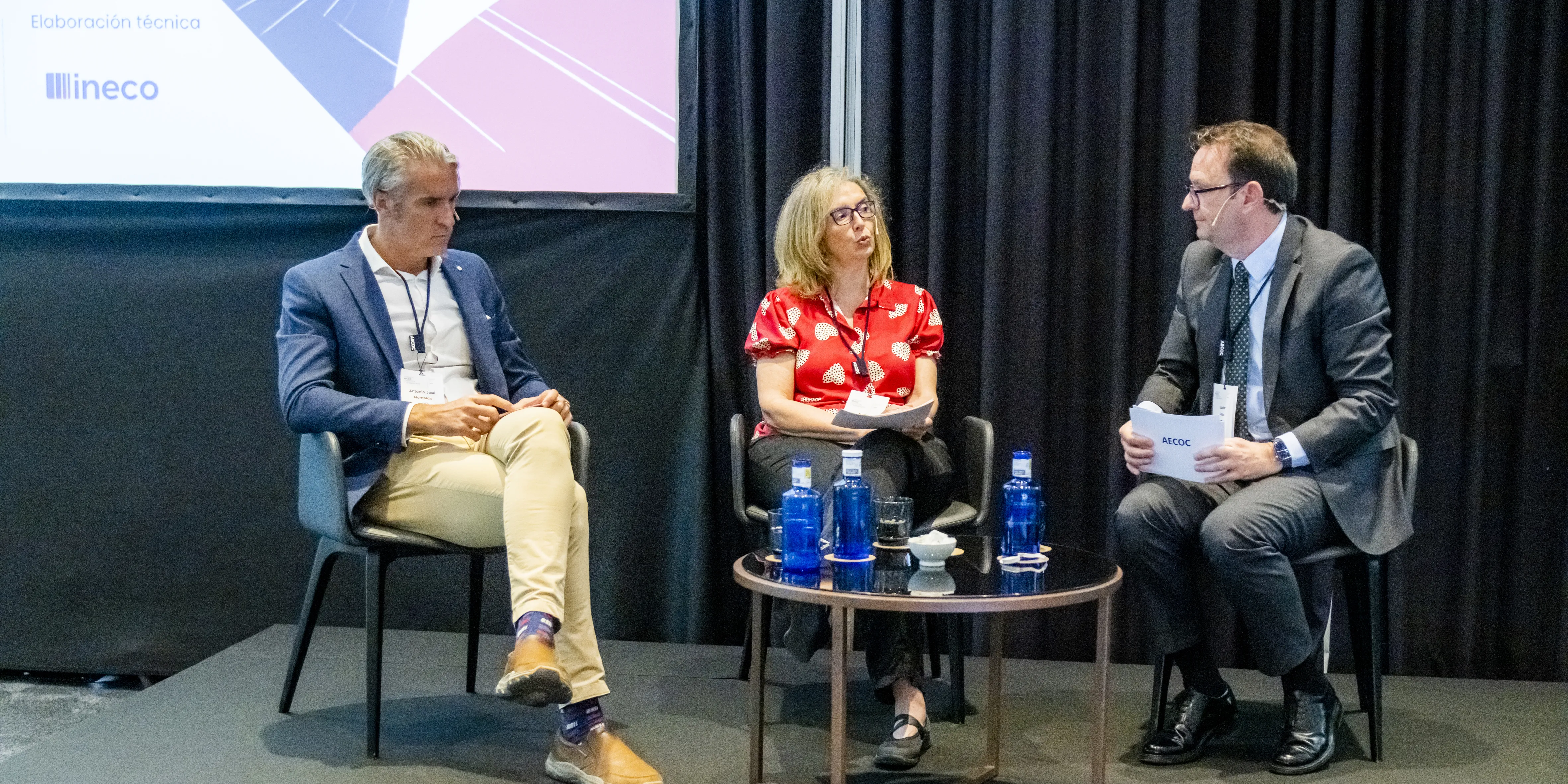
Ineco experts Antonio José Momblán and Nuria Alarcón present the Plan.
Rail freight offers capacity, efficiency and clear environmental advantages. Yet to become truly embedded in fast-moving consumer goods (FMCG) supply chains, it must take a further step: adapt to the pace of a sector where reliability, frequency and real-time data are paramount.
This is the premise behind the 2026 Intermodal Transport Plan for the FMCG Sector, promoted by the Office of the Atlantic Corridor Commissioner in collaboration with AECOC, with the participation of Ineco. The project is the subject of a feature article in Tramos, the magazine published by Spain's Ministry of Transport and Sustainable Mobility.
Ineco's contribution has focused on mapping the FMCG logistics landscape, identifying the barriers limiting rail's modal share, and translating the operational requirements of manufacturers and distributors into practical service criteria. The objective is clear: to move towards a genuinely competitive offering. As Antonio Momblán, Ineco expert in Transport Economics and Policy and one of the plan's authors, explains: "Demand already exists; the challenge now is to build an offer capable of meeting it."
This principle underpins the entire initiative. The priority is no longer simply to expand infrastructure, but to ensure rail services fit seamlessly into supply chains defined by tight deadlines and highly volatile demand.
The Master Train and Flexible Models
Building on this analysis, the Plan introduces the concept of the Master Train. Rather than a physical train, it is a benchmark model based on five core pillars: reliability, economic competitiveness, robustness, sustainability and transparency. It provides a roadmap for how rail freight services must evolve to deliver exactly what the market requires.
Achieving this vision will depend on more flexible operating models. Among the most promising are multi-client services, designed to consolidate freight from different companies and maximise capacity utilisation on each journey. In this regard, Nuria Alarcón, one of the plan's authors and an Intermodal Transport specialist at Ineco, highlights that the key "lies in creating the right conditions: greater digitalisation, increased visibility of demand and collaborative models capable of managing this complexity efficiently and sustainably."
Digitalisation will be a decisive enabler. The real-time sharing of information on capacity, services and planning will be essential to accelerate decision-making across shippers, operators and infrastructure managers.
Ultimately, Ineco's work points to a fundamental conclusion: the future of intermodality is not simply about moving more freight by rail. It is about enabling rail to adopt the same logic, responsiveness and customer focus that already define today's marketplace.