
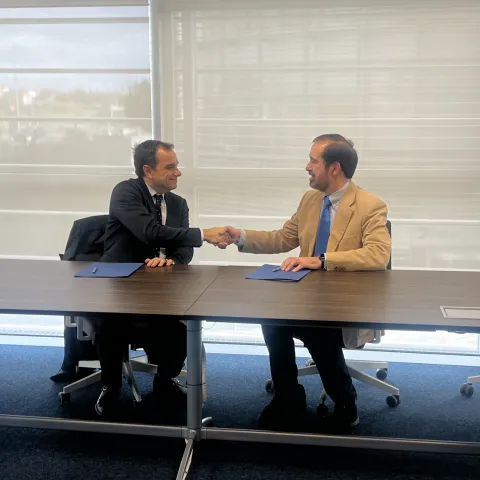

Sergio Vázquez Torrón, President of Ineco, alongside Raúl Medina, Managing Director of IH Cantabria.
Ineco and the Institute of Environmental Hydraulics of the Universidad de Cantabria (IHCantabria) have signed a collaboration agreement for the development of an advanced methodology to characterise the maritime port climate and analyse its impact on the operation of port terminals.
This agreement, with an initial duration of twelve months, combines Ineco's experience in port engineering, transport and logistics with IHCantabria's scientific knowledge in marine climatology, hydrodynamics and ocean-meteorological modelling, with the aim of improving the safety, efficiency and resilience of port infrastructures.
The project is part of Ineco's iCampus network, an innovative programme that has allowed it to advance in the development of innovation projects framed in nine different agreements with leading universities in Spain for the promotion of scientific-technical research, knowledge transfer and interaction between experts from the scientific, technical and business community.
Ineco works closely with the Materials Science and Engineering Division Laboratory of the Universidad de Cantabria, as a result of which it has developed projects dedicated to the resilience of rail superstructure fastening systems in the face of high temperatures; or the Raman method for the identification of rail stresses.
Innovative methodology to anticipate how climatic factors influence the port's operability
This new agreement will enable progress to be made in the integrated analysis of variables such as waves, wind, tides or sea level, as well as in the identification of operational restrictions affecting manoeuvres, berthing and loading and unloading operations. Based on these analyses, an innovative probabilistic methodology will be developed to characterise port operations under different climate scenarios, including future scenarios associated with climate change.
The project is structured in several phases ranging from the definition of requirements and selection of a study terminal, to the numerical modelling of maritime conditions and the sharing of results in a final technical report. This approach will generate knowledge that is applicable and transferable to other port environments, reinforcing decision-making in infrastructure planning, design and management.
With this initiative, Ineco consolidates its role as a benchmark in the development of innovative solutions for transport and infrastructures, incorporating climate adaptation and resilience criteria in line with the objectives of sustainability and ecological transition. The agreement also reinforces collaboration between the scientific and applied engineering fields, promoting the transfer of knowledge and the generation of value for the port system.
This collaboration represents for both entities an exceptional opportunity to generate applied knowledge, strengthen decision-making in port management and contribute to the development of innovative solutions based on science and technology.