
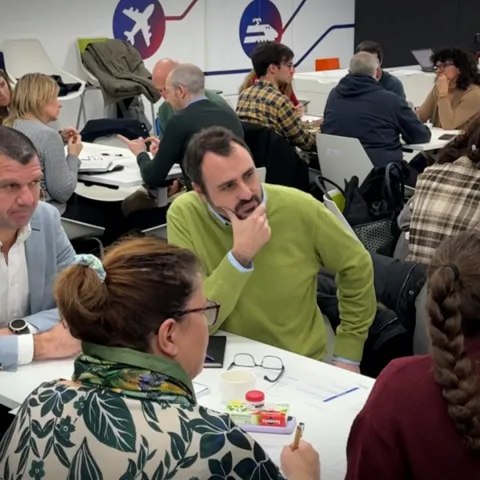
Ineco has held its Mov.ia Open Innovation workshop, this time focusing on Quantum. The meeting brought together SMEs and startups from the sector together with Ineco professionals to continue consolidating knowledge on new technological trends.
The event was opened by Víctor Bustos, Ineco’s Innovation Manager, who emphasized the company’s commitment to fostering a collaborative ecosystem around quantum technology. He noted that the initiative aims to leverage Ineco’s momentum to drive the adoption of quantum solutions. The event seeks to build on the recent innovation call to train teams in these emerging technologies and explore how quantum can be applied to future infrastructure and systems.
The aim of the conference was to increase Ineco's already consolidated commitment to sustainable innovations, exploring on this occasion computing, communications and quantum sensing to infrastructures or systems so that they can help in tasks such as the optimisation of operations or decision-making. Within this framework we find technologies such as QKD (Quantum Key Distribution), which consists of using quantum physics to generate and distribute encrypted keys.
The invited companies presented their proposals, which ranged from financial solutions to data transfer and migration. Eurecat presented its technology for transferring knowledge to multi-technology and multi-sector companies, while Qcentroid specialises in encryption and security. Qside, on the other hand, generates random numbers thanks to this technology, which it implements in satellites, defence and data centres. Multiverse Computing, meanwhile, presented its applied AI approach to developing solutions, such as real-time satellite surveillance, similar to Global Data Quantum, which operates in the energy, transport and financial sectors. Quantum Computing Solutions presented its technology to enable support for companies looking to migrate their technology.
This event inaugurates the cycle of workshops for next year's call for innovation 2026. The next ones will take place in January and will focus on dual infrastructure, crisis management and sustainability and prevention.