
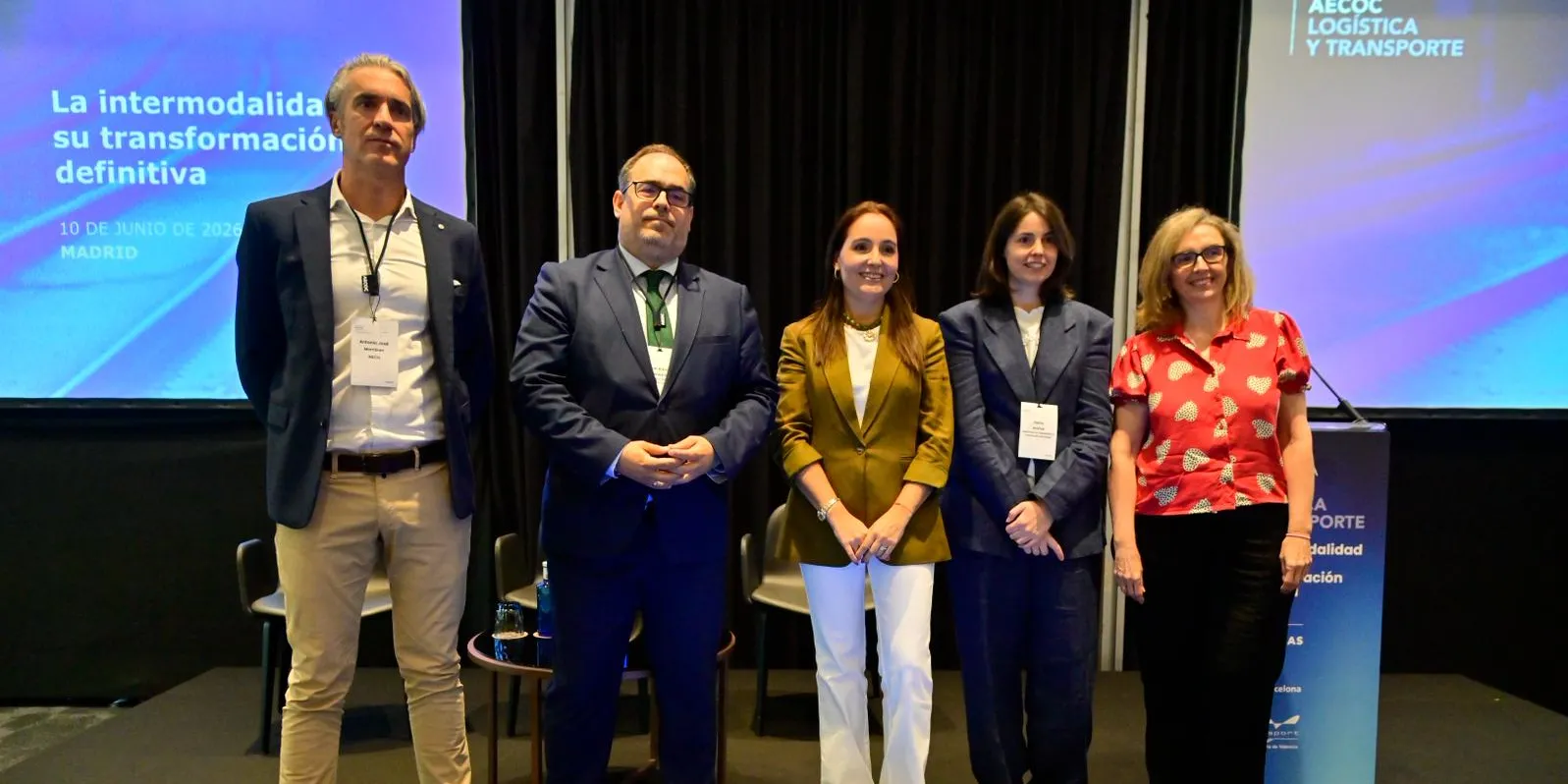
Antonio José Momblán and Nuria Alarcón of Ineco, leads of the FMCG Intermodal Transport Plan, alongside the Atlantic Corridor Commissioner, José Antonio Sebastián; María Tena, Director of Transport and Logistics at AECOC; and Elena Atance, Director-General for Road and Rail Transport at the Ministry of Transport and Sustainable Mobility.
Ineco has played a pivotal role in drafting the Intermodal Transport Plan for the Fast-Moving Consumer Goods (FMCG) sector 2026, developed by the Office of the Atlantic Corridor Commissioner, with the collaboration of the Spanish Association of Manufacturers and Distributors (AECOC). The plan serves as a roadmap to boost the use of rail in one of Spain’s most important economic sectors. The company provided technical support throughout the process, drawing on its specialised expertise in transport planning and freight logistics.
As part of the plan’s development, Ineco’s team carried out extensive consultancy work aimed at identifying the real needs of logistics and transport companies within the FMCG sector, as well as the barriers currently hindering greater use of rail. The document updates the last sector analysis undertaken by the Ministry of Transport and Sustainable Mobility a decade ago and offers a comprehensive snapshot of a sector that remains a key driver of the Spanish economy. According to the study, FMCG generates revenues of €843 billion and employs 2.8 million people (equivalent to 13% of the country’s workforce).
Nuria Alarcón and Antonio José Momblán, who led the plan on behalf of Ineco, presented the main findings at the event. The study highlights that, despite broad agreement on the environmental and operational advantages of rail transport, its presence in FMCG supply chains remains limited. Logistics managers consulted agree that rail has the potential to become a competitive alternative to road transport but stress the need for improvements in areas such as capacity and operational flexibility.
A central contribution of the plan is the proposal of a new standard known as the “Master Train” (Tren Maestro), designed to translate shippers’ needs into concrete technical and operational requirements for the rail system. Rather than a specific service, it is conceived as a benchmark model aimed at aligning all sector stakeholders around a more efficient offering tailored to market demands. The Master Train is built on five strategic pillars: service reliability, competitiveness with road transport, operational robustness, environmental sustainability, and transparency through digital tools enabling real-time tracking of goods.
The study also concludes with a ten-point set of recommendations to foster the growth of rail freight. Key measures include improving operational reliability, increasing service frequency and capacity, implementing multi-client models to achieve economies of scale, optimising processes at intermodal terminals, and strengthening coordination among all actors involved in the logistics chain.
During the presentation, the Atlantic Corridor Commissioner, José Antonio Sebastián Ruiz, emphasised the importance of advancing towards a more efficient and sustainable logistics model. He stated that the goal is to position rail as the backbone of freight logistics chains, offering an alternative capable of matching the reliability and competitiveness of road transport. He also underlined that the plan was developed “with the technical rigour of Ineco and the market insight of AECOC and its partners”.
Ineco’s involvement in this project reinforces the company’s contribution to the development of sustainable mobility and logistics solutions, providing specialised technical expertise to enhance the competitiveness of freight transport and support the transition towards a more efficient, low-carbon model.