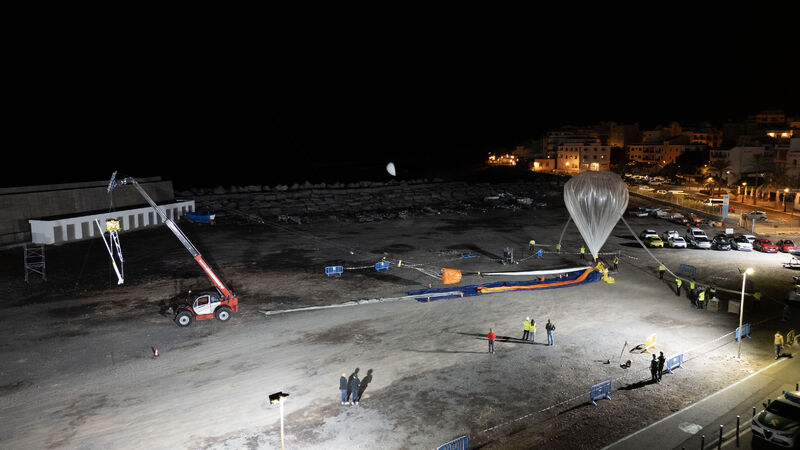

Ineco has taken part in the Rockoon operation carried out in Valle Gran Rey, on the island of La Gomera. This complex mission marks a significant step forward in the coordination of aerospace operations above 20 kilometers in altitude, commonly referred to as upper airspace.
The coordination of this operation was led by Ineco’s Higher Airspace Operations (HAO) team, working in collaboration with ENAIRE’s Airspace Operational Coordination Department. Their role was to ensure flight safety in a highly specialized airspace environment above flight level FL660 (approximately 66,000 feet or 20 km altitude).
An Innovative System for Space Access
The Rockoon operation involved launching a hybrid system that combines a stratospheric balloon with a solid-fuel rocket, weighing around 180 kg. This system was developed to validate key technologies for future deployments of microsatellites into low Earth orbit (LEO), a rapidly growing segment in the space sector.
The balloon reached an altitude of 21.5 km, from which the rocket was launched. A successful recovery followed, thanks to precise calculations based on high-altitude wind models and meteorological simulations. This predictive capability was essential to safeguard the mission’s integrity and ensure environmental safety.
High-Level Operational Coordination
The operation brought together key stakeholders such as ENAIRE, the Canary Islands Control Center, the Spanish Air Force General Staff, and the Civil Guard. Through its HAO team, Ineco acted as the technical and operational liaison for ENAIRE between civil and military authorities and operators, ensuring temporary airspace segregation without impacting conventional traffic. Víctor López and José Luis Herranz, from Ineco’s Airspace Management division, oversaw the coordination of Upper Airspace Operations to guarantee safety during the launch.
Rockoon: Efficiency and Innovation Driving the Future of Space
This type of launch, known as Rockoon, offers competitive advantages over traditional methods:
- Lower costs and fuel consumption, by avoiding friction in the densest layers of the atmosphere.
- High flexibility, as launches can be carried out from remote locations or mobile platforms such as ships.
- Direct applicability for deploying nanosatellites and CubeSats into very low Earth orbits (VLEO), essential for telecommunications, Earth observation, and data services.
Although the Rockoon concept was first explored in the 1950s, its commercial potential has recently been rediscovered by companies such as B2Space, Zero 2 Infinity, and TAO GmbH, ushering in a new era of cost-effective access to space.
Valle Gran Rey, en la isla de La Gomera
-
Image