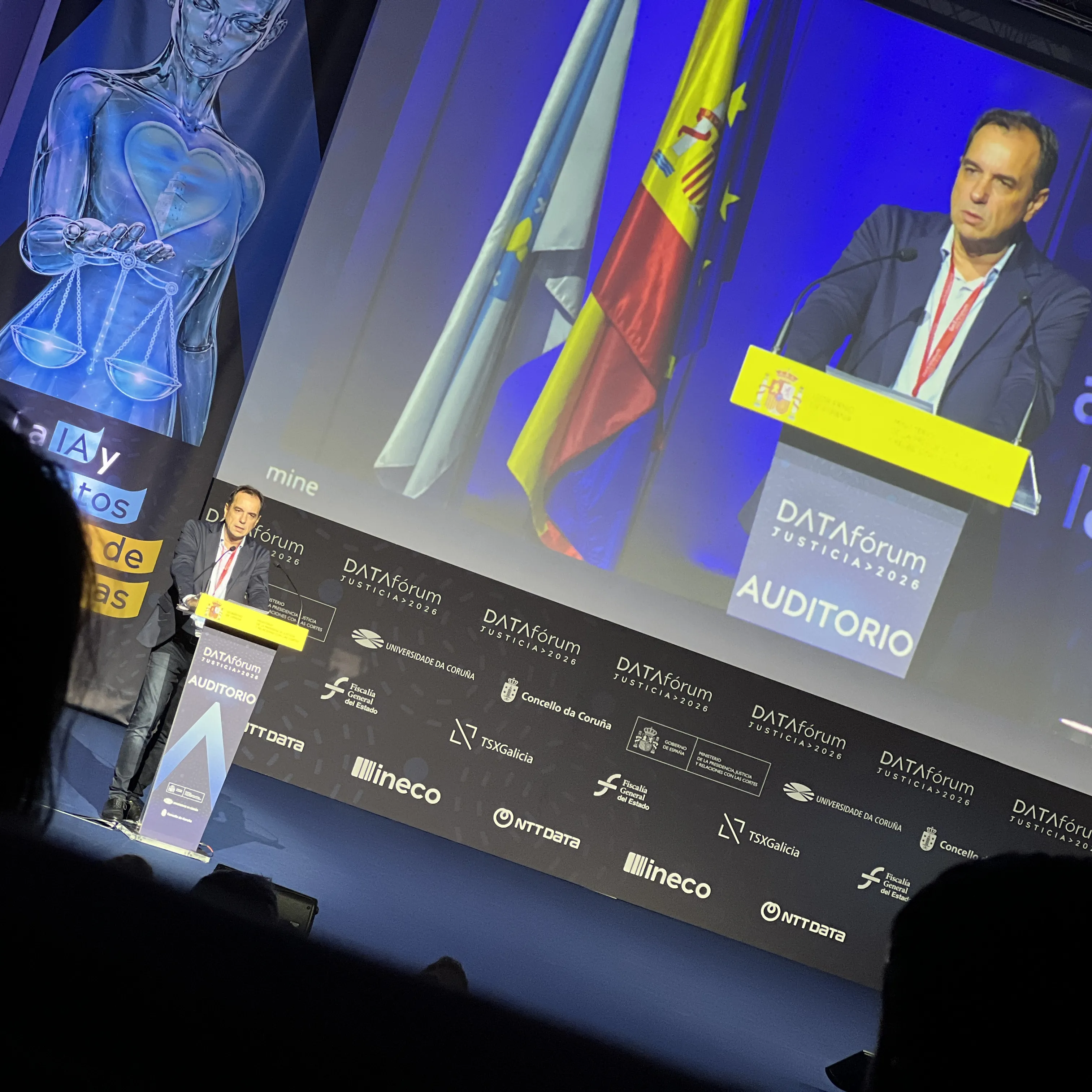



At the opening of the event, Ineco’s chairman, Sergio Vázquez, also stressed that “Ineco brings proven technical expertise, a strong understanding of the operational context of public administration, and a vision fully aligned with the common good.”
Artificial intelligence has moved beyond being a technology of the future to become a tool with real capacity to transform the relationship between citizens and public administration. The challenge is no longer experimentation, but rather building a model capable of scaling useful, secure and sustainable solutions across the public sector.
This is one of the key messages of a report presented by Ineco on artificial intelligence and public administration, unveiled during an event attended by María González Veracruz, Secretary of State for Digitalisation and Artificial Intelligence. She argued that “AI is not just a technological challenge, but an ethical, philosophical, institutional and democratic one.” In his opening remarks, Ineco’s chairman, Sergio Vázquez, highlighted that the organisation brings “proven technical expertise, knowledge of the administrative environment, and a vision fully aligned with the common good.”
González Veracruz emphasised that “talking about AI in the public sector today is no longer about the future, but about the present: how we deliver public services, how we make decisions, and how we want the relationship between institutions and citizens to evolve. When we speak about public AI, we are talking about competitiveness and technological sovereignty, but also about democracy, rights and trust. Spain is moving decisively in this direction, positioning itself at the forefront in Europe with a deeply human-centred vision of technology.”
She also highlighted “concrete projects already delivering real impact, such as those developed under the Govtechlab initiative, a public innovation laboratory focused on artificial intelligence within the Spanish administration. We have driven 19 use cases, some involving Ineco, including a sovereign AI agent for internal administrative use and another to optimise weather forecasting. These are examples of how the administration is embracing new technologies to become more efficient, more humane and more accessible.”
The report examines how to integrate AI into public services from the perspective of public value, governance and trust. It is based on a clear premise: AI will only be truly useful if it simplifies the citizen experience, streamlines procedures, and improves the quality and consistency of public decision-making. According to the report, achieving this requires more than isolated pilot projects or standalone tools. It calls for the development of shared, reusable and measurable capabilities that can underpin a coherent strategy.
Governance Challenges for Coordinated Deployment
In this context, one of the report’s main proposals is the creation of a federated Centre of Excellence, conceived as a technical and methodological support structure for public administrations as a whole. Its aim would be to accelerate the deployment of AI solutions with appropriate safeguards, avoiding duplication and promoting the reuse of models, components, data and lessons learned across institutions.
The report envisions this Centre of Excellence as a coordinating and assurance hub, capable of supporting administrations in the evaluation and implementation of AI solutions. It would establish common standards for maturity, data quality, human oversight, accessibility, explainability and risk management.
It also advocates the introduction of a common system for assessing the maturity of public-sector AI, enabling each organisation’s level of readiness to be diagnosed and minimum thresholds to be defined before solutions are brought into production. This tool is intended not only to structure technological deployment, but also to ensure it follows consistent criteria, proportionate to risk and aligned with the public interest.
Spain, the report concludes, already has a strong foundation in digital administration. The challenge now is to transform this accumulated experience into leadership by combining infrastructure, governance, talent and organisational capacity to deliver a public AI that is both useful and trustworthy.
Ultimately, the success of this transformation will not be measured by the number of algorithms implemented, but by something far more tangible: whether citizens perceive a simpler, clearer and more effective administration.
The full report is available for consultation, here.